
Show jumping obstacles are a core element of one of the most striking and popular disciplines in equestrian competitions. This event consists of a course that the horse-and-rider pair must complete in the shortest time possible. There are various types and difficulty levels, allowing for competitions tailored to different levels of experience. As a result, there is a wide variety of jumps that enable highly engaging combinations.
At Equspaddock, as manufacturers of equestrian accessories, we produce many of these obstacles. This gives us firsthand knowledge of every type available and the best time to deploy them. In this article, we explain everything you need to know!
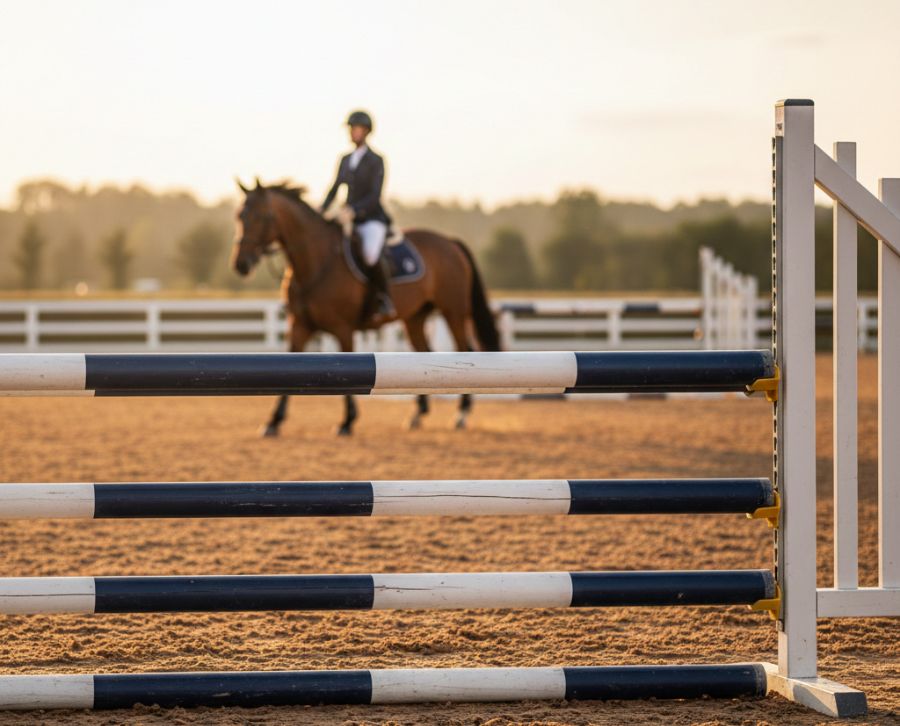
What is a show jumping obstacle in equestrianism?
Before discussing the different types of horse jumps, it is essential to understand what they are. These obstacles are structural elements strategically placed along a course for the horse-and-rider pair to jump and clear without knocking them down. Therefore, they are strictly regulated by the FEI (International Federation for Equestrian Sports) and must be positioned at precise points to ensure safety and efficiency at all times.
Definition and function in the jumping discipline
When explaining exactly what equestrian obstacles are, they are rigid structures that the horse must jump to pass without knocking down or touching them. They can have different difficulties, as they may consist of a single obstacle or several combined. Therefore, size, height, width, and specific requirements vary.
This discipline allows for the assessment of the efficiency, precision, balance, strength, and technique of the horse-and-rider pair. Depending on the terrain, surface, and competition level, obstacles are distributed in various ways to test the combination’s skills.
Basic FEI Regulations on obstacles
The International Equestrian Federation (FEI) is the governing body that regulates the standards for show jumping obstacles. Obstacles must meet specific measurements based on the rider’s experience level, and safety must be guaranteed at all times.
They must be securely supported to avoid harming the horse or falling unnecessarily during competition; therefore, specific and safe FEI-approved jump cups and supports are used. Additionally, jumps must have a maximum frontal height, depending on the type of obstacle. Each jump must be marked with red and white flags to indicate the required direction and must be numbered.
Main types of show jumping obstacles
There are different horse jumping obstacles, classified by their measurements and uses. Here are the most common types and how to clear them:
Vertical obstacle: Pure height
A vertical jump (Vertical) consists of horizontal poles placed directly on top of each other in a single vertical plane. This jump tests the animal’s “height” capacity and its ability to lift and tuck its legs. It is one of the most common jumps at all competition levels. All verticals must be stable, rigid, and safe to prevent injury to the horse.
Oxer: Width and progressive difficulty
An oxer (also known as a spread jump) is a “width” obstacle formed by two verticals placed in parallel. The horse must jump both high and wide to clear the two sets of poles together. There are two main types: the Square Oxer (both rails at the same height) and the Ascending Oxer (the back rail is higher than the front). It is used in more advanced levels as it requires power, extension, and scope.
Triple bar: A test of scope and power
This obstacle consists of three consecutive verticals of increasing height. The horse must make a deep and powerful jump. It evaluates the horse’s ability to clear a wide distance and is widely used in medium and advanced competitions.
Liverpool: Jumping with a ditch or water
A Liverpool jump consists of a vertical or an oxer placed over a small tray of water or a ditch. These help the horse adapt to jump depth and visual distractions. While not used in every local show, they are very common in training and professional circuits.
Wall: A test of confidence and precision
In appearance, it looks like a solid brick wall, but it is built with lightweight materials (such as foam or hollow plastic) that fall easily if touched, ensuring the horse’s safety while testing its focus.
Crossrail: Highly popular
This jump is the most common starting point in the discipline. It consists of two poles crossed in an “X” shape, creating a low point in the center to help the horse and rider stay balanced.
Other special obstacles in competitions
Depending on the difficulty, a course may include more complex options:
-
Open Water (Ría): These are long jumps where the horse must clear a wide water ditch without touching the boundary line or landing in the water.
-
Combinations: A jump is considered a combination when two or three obstacles are placed close together (maximum of two strides apart). They are labeled A, B, and C, and can be “Doubles” or “Triples.”
Eventing uses a different family of jumps altogether: solid, fixed elements designed to be jumped at speed over open ground. See the specific range of cross-country obstacles and accessories we manufacture for eventing courses.
When to use each type of obstacle?
The combination of obstacles can vary widely based on the type of competition, experience level, and modality.
Basic training with verticals
Training jumps usually start with verticals, as they are the simplest way to teach technique and correct jumping position. They are also used for warming up or in the initial phases of more difficult courses.
Technical progression with oxers and triples
Oxers and triple bars are used to train the horse’s hindquarter strength and extension. To perform these, the horse-and-rider pair must first master vertical jumps.
Developing confidence with Liverpools and walls
Walls and Liverpools are key elements for the animal to build confidence when facing unfamiliar visual stimuli. It is essential that the pair has prior experience and works in total sync.
Preparing full courses
In advanced competitions, all types of obstacles are combined. In entry-level shows, courses mostly consist of verticals and small oxers. Designing a show jumping course requires considering experience, decorative elements, recovery points, and obstacle distribution.
Recommended measurements and materials for each obstacle
The FEI regulates the required dimensions to ensure best practices and horse safety.
Regulatory height and width
The maximum height of a jump depends on the level. Verticals can reach up to 1.60m, while some oxers do not exceed 2m in spread. Triple bars vary but must always follow a safe progressive height.
Materials: Wood, PVC, and safety elements
At Equspaddock, we manufacture elements that are safe, firm, and adaptable. We recommend high-quality PVC for durability and treated wood for a traditional feel, always using safety release cups.
Visibility rules and color contrast
It is vital to follow visibility and signaling rules so the rider knows the direction and difficulty of the test. Obstacles should avoid distracting advertisements that may break the pair’s focus.
How to design a balanced jumping course
Designing a course requires following FEI obstacle regulations. A balanced circuit must be adapted to the competition’s level.
Alternating simple and combination obstacles
A course usually begins with simpler options like verticals, moving towards oxers and combinations to make the competition more challenging and complete.
Recommended number of jumps per level
-
Introductory levels: 8 to 10 simple jumps.
-
Intermediate levels: 10 to 12 jumps with basic combinations.
-
High competition: Longer courses with complex double and triple combinations.
Tips for clubs and local competitions
Always choose obstacles made from quality materials. Gradually increase difficulty as the horse-and-rider pair progresses.
Show jumping equipment recommended by Equspaddock
Arena equipment should match its use, the training level and the type of courses you plan to build. At Equspaddock we manufacture show jumping obstacles and design show jumping solutions for training, arena renovation and competitions.
It also pays to review your riding arena material as a whole: you can plan spare parts, combine elements better and avoid buying items that are barely used.
Complete obstacles and competition jumps
Complete horse jumping obstacles let you set up varied courses with a base of equipment that is ready to work from day one. You can combine heights, designs and layouts to suit each horse-and-rider pair and the size of the arena.
Poles, wings and spare jump cups
Show jumping poles and supports are the parts that suffer the most wear, so it is worth keeping spares to replace a piece without stopping the session. Having extra poles, safety cups and supports keeps the arena fully operational. We make them in wood or PVC, with different finishes and sizes.
Cavaletti and ground poles for groundwork
Cavaletti and ground poles help work on rhythm, coordination and placement before moving on to more demanding exercises. They make sessions more varied, help adjust distances and adapt the work to each horse’s level.
How much does it cost to equip a show jumping arena? What to ask for in a quote
The cost of horse jumps depends on the size of the facility, the amount of equipment, the training level and the degree of customisation. To compare quotes properly, check that they include:
- Quantity and types: which pieces are included (verticals, oxers, triple bars, walls…) and how many units.
- Materials and finishes: wood or PVC and the options planned for how the arena is used.
- Included components: poles, fillers, wings, cups and spare parts.
- Supply: customisation, transport and delivery terms.
This way you will know exactly what each quote includes and can better assess the investment.
Table: minimum obstacles for a beginner club, a local competition venue and a show venue
Use this table as a reference to plan a show jumping course according to how your centre is used. Exact quantities should be defined for each arena.
| Type of centre | Core equipment |
|---|---|
| Beginner club | Verticals, crossrails, poles and equipment for basic exercises (cavaletti and ground poles). |
| Local competition | Verticals, oxers, combinations and spare parts to vary the courses. |
| Show venue | A wider set (triple bars, walls, water jump or Liverpool), combinations, numbered marker pyramids and spare parts suited to the level of the classes. |
Request a quote for your custom show jumping obstacles
At Equspaddock we manufacture equipment to set up an arena from scratch, expand your current set or replace worn parts. If you need show jumping solutions, request a quote for your obstacles and we will help you define a proposal tailored to the size, level and use of your facility.
Tell us about your arena and we will prepare a proposal with the equipment you need to get the most out of it.

