
Show jumping poles for horses are a critical component in high-performance equestrian sports, where every jump represents a significant investment. Their design and quality define the safety of the pair and the fairness of the competition; the integrity of every performance depends on them.
At Equs Paddock, we have spent years manufacturing professional equestrian equipment and understand the industry’s nuances deeply. Let’s explore what these devices consist of and what you should consider when buying them for your equestrian center.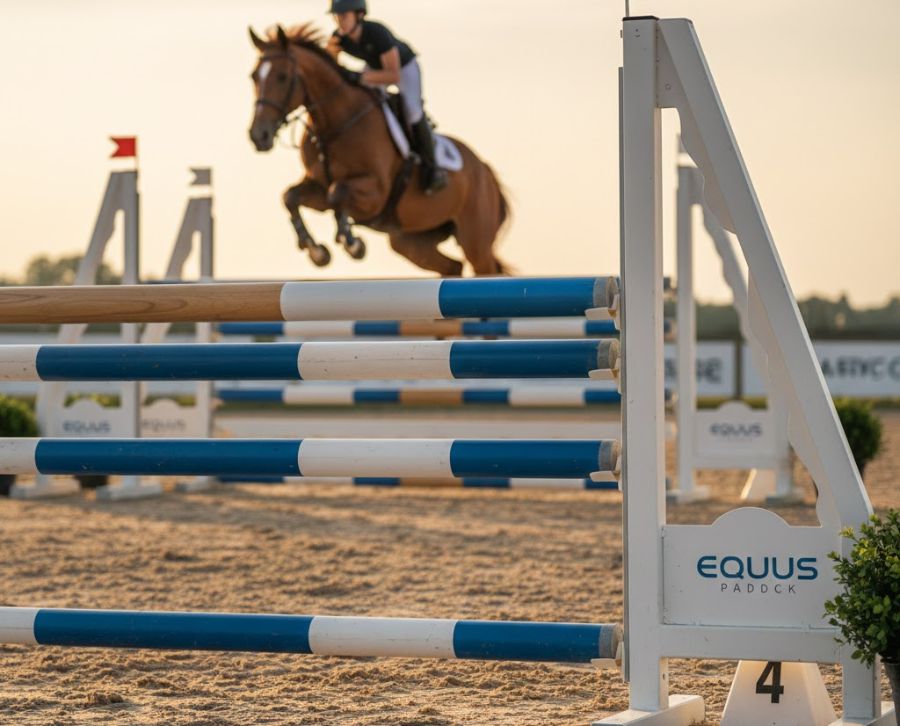
What are show jumping poles for horses?
In equestrian competitions, show jumping poles are an essential element. They consist of a rail placed across two jump wings (standards) that can be easily knocked down, forming the obstacle that the horse-and-rider pair must clear.
Function and use in training and competition
During training, equestrian jumping poles help improve the horse’s technique and agility. They are versatile elements that allow riders to recreate various competition scenarios. In a competitive setting, these elements are arranged to challenge the pair, such as in parallel (oxers) or vertical configurations.
Differences between decorative and functional poles
There are functional jumping poles made from durable and resistant materials, such as professional-grade PVC, which comply with the official regulations mentioned below. Decorative poles are not manufactured with such precision; they are used where jumping is infrequent and are not considered suitable for serious training or competition.
What to consider when buying jumping poles?
Are you looking for affordable equestrian jumping poles? You must keep several details in mind, as this decision directly impacts the safety and progress of both rider and horse.
Recommended diameter by discipline and horse type
The diameter of the horse jump pole must be sufficient for the horse to have a clear visual reference. This is typically between 8 cm and 9.5 cm, although smaller diameters are used for beginners as they are less intimidating.
Standard length: 3 m, 3.5 m, or more?
Regarding length, the competition standard is 3.5 meters. This is the ideal measurement for the horse to detect it while ensuring it extends beyond the supports so it doesn’t tip over easily.
Ideal weight for rider and horse efficiency
Jumping poles must be light enough to fall easily upon impact, but heavy enough to remain stable in the wind. Lightweight poles can produce loud noises or sharp movements that startle the horse. Conversely, excessively heavy poles could cause injuries. Professional systems usually weigh around 8 kg.
Types of materials: Pros and Cons
Material choice is just as important as weight and dimensions.
Natural Wood (Pine, Fir, etc.): Offers a classic aesthetic and solidity. It is highly cost-effective but requires constant maintenance (painting and varnishing) to withstand sun and rain. If it splinters, it can be dangerous.
PVC and Synthetic Materials: These represent the future of equestrian jumping. They are highly durable and maintenance-free. Modern models are lightweight without sacrificing strength. While the initial cost is higher, the long-term maintenance savings are significant.
Combined or Coated Poles: The best of both worlds. A rigid wooden core for weight and feel, covered in a PVC sleeve. This protects the wood and eliminates the risk of splintering.
Maintenance and Durability
The lifespan of your investment depends on proper care.
When to replace them: Poles should be inspected before every competition or session to detect cracks or deformities. We recommend replacing wooden poles every two years due to weathering and continuous impact.
Storage: Never store poles outdoors. Use a dry, ventilated indoor area with racks to prevent warping.
Cleaning and Painting: For wooden poles, a damp cloth is sufficient. PVC can be cleaned with water and neutral soap. When repainting wood, sand it first, apply a primer, and use two coats of non-toxic, bright-colored paint for better visibility.
Official Regulations and Measurements
These obstacles must adhere to specific rules in sanctioned events.
FEI Rules: According to FEI regulations, jump systems cannot exceed 1.70 meters in height (except for record-breaking events). Poles must be able to roll in the cups, and safety supports are mandatory.
Heights and Distances by Category: Poles are typically set at 1.50 m for CSI 1*, 1.45 m for CSI 2*, and 1.60 m for CSI 3-5*. The standard distance between obstacles is between 7 and 12 meters.
Buying Quality Jumping Poles
Buying show jumping poles for horses transcends technical specs: it is a decision where you must prioritize the safety of the horse and rider above all else.
This is why Equs Paddock should be your supplier. We develop every component with the conviction that a true competitive advantage stems from reliable equipment. By integrating our solutions, your equestrian center takes a decisive step towards sustainable professional excellence.

